

Eroticism in the Tempest: Navigating the Sensual Seas of "Anne-Marie" by Reina Canalla

Dante Remy |

Reina Canalla’s Anne-Marie plunges into the deep waters of desire, power, shame, fantasy, and identity through a richly provocative tale set against the Caribbean world of the early eighteenth century. Wrapped in the language of historical adventure and piracy, it is far more than an erotic diversion. It is a story that understands what too many erotic comics forget: sex becomes unforgettable when it is fused to danger, repression, awakening, and transformation. That is one reason this work lingers.

The 240-page Deluxe Edition gathers the complete nine-book series into a substantial collector’s volume, accompanied by exclusive illustrations and an expanded presentation that gives the world of Anne-Marie a much fuller visual life than the separate installments alone. This matters. It means the reader encounters not a fragment, but a voyage. Brilliant color, additional imagery, and dramatic full-spread moments help the book feel less like a simple comic compilation and more like an erotic art object—something meant to be read, studied, revisited, and displayed. It is a collector’s edition in the fullest sense.
Eroticism In Liberation and Sexual Awakening

At the center of Anne-Marie is the theme of erotic liberation, and it is handled with greater intelligence than one often finds in the genre. Anne-Marie begins as a novice in a convent, and that matters deeply. The convent is not merely background. It is an erotic structure of repression—ritual, silence, surveillance, denial, discipline. It is a world where bodily feeling is treated as offense and desire is named as guilt. Anne-Marie’s sensual awakening inside that system, and her punishment and expulsion from it, form the psychological foundation of the story.
Her expulsion is not just a plot point. It is a rupture.
From that moment forward, the story becomes an inquiry into what happens when a woman trained to fear her body is cast into a world where power, appetite, and performance are no longer hidden beneath sanctity, but displayed openly and forcefully. Her subsequent crossing into the dangerous orbit of the pirate Jezzabel Avery becomes not only erotic initiation, but a crisis of selfhood. Pleasure is no longer abstract. It becomes lived, perilous, destabilizing.
And that is precisely why the eroticism works.
Too many erotic narratives confuse liberation with immediacy, as though a character sheds shame in a single scene. Anne-Marie appears more interested in the tensions that make transformation believable: fear, fascination, resistance, bodily betrayal, internal conflict, and the long afterlife of repression. Shame does not disappear instantly. It lingers. It complicates desire. It deepens the charge of surrender. The result is an erotic current that feels more volcanic than casual.
Eroticism in Power Dynamics and Role Reversal
The relationship between Anne-Marie and Jezzabel Avery is one of the great engines of the work. What begins as a captor-and-captive scenario grows into something more ambiguous, psychologically charged, and mutually transformative. Jezzabel is not merely a pirate seductress. She is a force. A catalyst. A figure through whom the conventions of pirate legend are recoded through female erotic dominance.
That shift matters.

In visual terms, Reina Canalla frequently stages Jezzabel with the iconographic confidence usually reserved for male pirate mythology: planted stance, commanding gaze, weapon or chain in hand, theatrical authority radiating from the body. But here that grammar is transformed. The pirate fantasy is no longer masculine conquest dressed in familiar costume. It becomes something bolder and more disruptive—a vision of female erotic sovereignty that is neither passive nor ornamental.
Jezzabel is not simply sexy. She is mythic.
And Anne-Marie’s reaction to that power is what gives the story its psychological tension. She is not merely overwhelmed or conveniently eager. She is drawn, unsettled, changed. Her attraction is inseparable from threat, from fascination, from the collapse of earlier categories. This is where Anne-Marie rises above disposable smut. Beneath the explicit content lies a genuine inquiry into power, submission, initiation, and self-invention.
Eroticism in Identity and Transformation
Anne-Marie is, in the deepest sense, a story about identity and metamorphosis. Anne-Marie’s movement from convent to pirate ship is not simply geographic. It is existential. The old language that once defined her—obedience, purity, discipline, transgression—begins to fail. What takes its place is uncertain, but fertile.
Who is Anne-Marie once the convent no longer names her?
Who is she when desire becomes not only a secret act, but a force with consequences?
Who is she when another woman’s power becomes both a threat and an invitation?
Who is she when the body stops being only a site of guilt and becomes a site of knowledge?
These are the questions that give the saga its depth. Through erotic encounters, humiliation, fascination, danger, and awakening, Anne-Marie is reconstructed. She moves from sheltered novice to a woman increasingly conscious of agency, appetite, and the unstable power of her own transformation. The story suggests that identity is not discovered in innocence, but forged in confrontation—with fear, with shame, with fantasy, with the forbidden.
Eroticism in Freedom vs. Constraint
The contrast between the convent and the pirate world is one of the most compelling structural oppositions in the book. These are not merely two different settings. They are rival erotic and moral systems.

The convent represents suppression, denial, ritualized control, and the policing of desire in the name of purity. The pirate ship, by contrast, offers exposure, appetite, spectacle, lawlessness, and a theatrical display of power. But Reina Canalla is not naive enough to present pirate life as simple freedom. The ship has its own hierarchies, performances, commands, and coercions. It is not innocence recovered. It is another order entirely.
That complexity gives the book force.
The real question is not whether Anne-Marie escapes into freedom. It is under what conditions she becomes herself. Not the innocent self. Not the punished self. Not merely the captured self. But the chosen self. The self that emerges only after crossing through shame and danger into knowledge.
That is the true voyage of Anne-Marie.
The Visual World of Anne-Marie
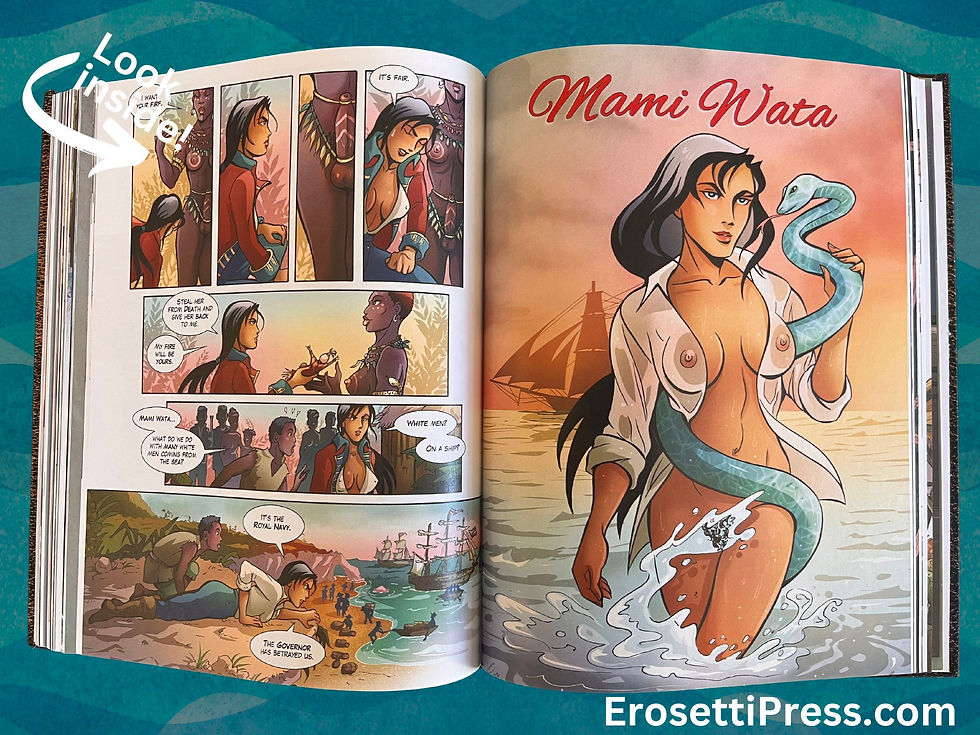
One of the most striking achievements of this saga is how clearly the visual language announces its themes. Even before the dialogue unfolds, the imagery tells the reader what kind of erotic world they are entering: women staged not as decorative objects, but as commanding, exploratory, imperiled, theatrical, dominant, bound, defiant figures. Convent iconography collides with pirate spectacle. Rope, blades, ritual punishment, masks, submission, feminine force, and storm-charged pageantry all work together to create a visual field of collision—faith and flesh, innocence and appetite, shame and initiation, captivity and awakening.

Reina Canalla’s style is bold, clean, and theatrical, with expressive faces and a palette that moves between candlelit flesh, chapel stone, parchment warmth, Caribbean sky, and operatic costume color. There is confidence in the staging, confidence in the page design, and confidence in how erotic imagery is shaped to feel authored rather than careless. This is not amateur provocation. It is erotic vision with aesthetic control.
The worldbuilding also deserves attention. Maps and front matter situate Saint-Domingue within a specific 1714 Caribbean milieu, and Jezzabel Avery’s routes through the region give the saga a broader adventurous framework. The result is not a random sequence of erotic episodes, but a full erotic-adventure universe with texture, movement, atmosphere, and symbolic weight.

Even the structure of the nine-part saga suggests deliberate progression: Hades, At the Tavern, The Kiss, The Binge, Portrait of a Pirate Lady, Pirate Family, The Monster, Mami Wata, and Climax. These are not arbitrary titles. They imply descent, encounter, appetite, myth, transformation, and culmination. The eroticism unfolds as saga, not fragment.
Reina Canalla and the Collector’s Shelf
The edition identifies Reina Canalla as Lara Lopez, a Spanish author, artist, and illustrator trained in drawing, painting, and comic illustration, and notes recognition including the Barcelona International Comic Fair Award and the Erotica Comics Award. That pedigree shows in the work. There is discipline behind the sensuality. There is stylization behind the explicitness. There is a distinct artistic hand throughout.
And that matters for readers who collect erotic comics seriously.

Serious collectors want more than explicit panels. They want worldbuilding, visual identity, recurring characters, atmosphere, a creator with a point of view, and artwork worth returning to after the immediate thrill has passed. Anne-Marie offers all of that. It gives the reader memorable characters, a charged symbolic world, lush and theatrical imagery, and a creator’s signature strong enough to invite further exploration.
That is what makes a book shelf-worthy.
A shelf-worthy erotic work gives you a story you remember, characters you can describe, images you want to revisit, and an artistic signature strong enough that you want more from the creator. Anne-Marie delivers.
A Reflective Mirror to the Modern Soul
Through all of this, Anne-Marie does more than tell the story of a pirate and a novice in the Caribbean. It holds up a mirror to enduring questions about the self. What does liberation actually look like? What remains in us after repression? How do shame and desire become intertwined? When does power awaken us, and when does it endanger us? How do we become ourselves after the old language of innocence has failed?
These are not small questions, and Reina Canalla does not treat them lightly.
That is why Anne-Marie resonates. It fuses eroticism with identity, danger, fantasy, role reversal, and symbolic transformation. It understands that explicitness alone is never enough. The body becomes most compelling when it carries psychological and mythic weight.
There are erotic comics that simply show bodies. And then there are erotic comics that stage a crossing—a crossing out of innocence, out of obedience, out of punishment, and into appetite, danger, and self-invention. Anne-Marie is that kind of work.
It offers readers a heroine formed by repression and then hurled into the storm. It offers a pirate woman who is not an accessory to fantasy, but its commanding force. It offers imagery that is lush, transgressive, and unashamedly stylized. And above all, it offers that old irresistible erotic promise: that somewhere beyond fear, beyond discipline, beyond the laws that named desire a sin, another life waits.
If that sounds like the kind of book you want in your collection, then yes—Anne-Marie is one erotic comic saga to have on the bookshelf.
Learn more about Anne-Marie and explore purchase options at ErosettiPress.com. To discover more of Reina Canalla’s erotic comics and original creations, visit ReinaCanallaArt.com.
©️2024, Updated 2026 by Dante Remy


Comments