

Eric Stanton and the Golden Age of Fetish, Leather, and Bondage Illustration and Story

Updated: May 15
Dante Remy |

There are artists who work inside a genre, and then there are artists who give that genre its enduring face. Eric Stanton belongs in the second category. He did not simply draw fetish; he helped codify its visual language for the modern era. Born Ernest Stanzoni Jr. in Brooklyn in 1926, Stanton built, over more than fifty years, a private empire of heels, corsets, gloves, masks, captivity, humiliation, theatrical reversal, and unapologetic female command. His women were not decorative. They ruled the page. His men were not romantic heroes. They were frequently bewildered, chastened, transformed, outflanked, or absorbed into systems of power larger than themselves. In Stanton’s hands, fetish was not a side current of American visual culture. It was its own underground republic.
And that is why he still matters. Eric Stanton remains one of the central architects of twentieth-century erotic illustration precisely because he understood something many later imitators did not: fetish works when it becomes a total world. In Stanton, clothing is destiny. Posture is hierarchy. Leather is not merely texture but command. Corsetry is not ornament but structure. Bondage is not just restraint but narrative. The scene is never casual. It is staged, heightened, ritualized, often funny, and nearly always charged with a severe elegance that makes the work feel both lurid and composed. The Guardian’s obituary of Stanton described him as America’s most influential postwar illustrator of bondage and domination, and that judgment still holds up because so much of what mainstream culture later absorbed through fashion, music, pulp revival, dominatrix iconography, and fetish art had already been sharpened in Stanton’s ink.

This is why the appearance of Eric Stanton’s Bondage Enthusiasts Bound in Leather Volume One: Restored Edition from Erosetti Press matters. The book is now listed through Amazon under that title, and it arrives not as a disposable curiosity but as a work positioned for preservation, rediscovery, and serious collector attention. It deserves that treatment. Stanton has too often been spoken of in fragments: as gossip adjacent to Bettie Page, as a footnote to Steve Ditko, as a “bizarre” underground specialist, as a cult paperback cover artist, as the father of fetish, or as the artist behind a handful of famous bondage serials. All of that is true, but none of it is enough. Stanton deserves the longer telling.
Brooklyn Beginnings: Wonder Woman, Sheena, and the Making of a Muse
The essentials of Stanton’s early formation are as revealing as anything he drew later. By age twelve, he was already copying the strong heroines of early comics, especially figures such as Wonder Woman and Sheena. That fact matters because it explains that his later fetish art did not arrive from nowhere. Before the ropes, straps, corsets, and apparatus, there was already an eye fixed on women who dominated the frame. He was drawn to forceful female presence long before that fascination hardened into the fully theatrical fetish grammar that made him famous.

By his mid-teens, surviving original art tied to his wartime gag panel Tin Hats shows he was already producing professional-looking work associated with Bell Syndicate in the early 1940s. That early output is important not simply as trivia, but because it demonstrates how young Stanton was when he began learning the disciplines of repeatable cartooning: pacing, gesture, economy, silhouette, and the ability to make an image read instantly. Even before he became the supreme draftsman of erotic hierarchy, he was already learning how to control a page.
War, Service, and the Severe Logic of Black and White
After leaving high school in 1944, Stanton entered the U.S. Navy. During service he produced aircraft-recognition strips for military publication and entertained fellow sailors by drawing glamorous women on handkerchiefs. That combination already sounds unmistakably like Stanton: technical utility by day, fantasy by instinct, female glamour as recurring compulsion. Later biographical accounts also connect his wartime experience to a head injury and a period of partial color-blindness. Whether or not one wants to assign too much artistic causation to that episode, it is striking that Stanton’s most unforgettable work depends so powerfully on black-and-white contrast, emphatic contour, dramatic shadow, and hard visual separation. His art does not rely on delicacy. It relies on force.
That high-contrast severity became one of his signatures. Stanton’s pages often feel less like ordinary comic illustration than like command diagrams of desire. His women emerge from darkness with sculptural clarity. Gloves gleam. Boots slice the leg into a weaponized shape. Corsets turn the torso into architecture. Faces hold cool certainty even when the surrounding scene borders on comic absurdity. Black and white, in Stanton, becomes moral as much as visual: domination and submission are not blurred; they are staged.
Boody Rogers, Professional Craft, and the Apprenticeship Behind the Fetish
After the war, Stanton’s first important step into paid illustration came through Gordon “Boody” Rogers, the newspaper strip cartoonist behind Sparky Watts and Babe, Darlin’ of the Hills. Stanton assisted on backgrounds, lettering, coloring, and character invention. That apprenticeship matters enormously. It reminds us that Stanton was never just an eccentric underground fantasist scribbling private obsessions in isolation. He learned from actual production labor. He learned deadlines, cartoon mechanics, the choreography of bodies in motion, and the practical discipline of making images function in sequence.
That background helps explain why even Stanton’s most bizarre work rarely feels static. He was a scene-builder. He knew how to lead the eye. He knew how to make costume, gesture, and placement tell a story before a reader had finished the accompanying text. Even in fetish illustration, he remained fundamentally a narrative artist. His images ask: who is in charge, how did we get here, what humiliating transformation is underway, and what will happen next? That storytelling intelligence is one of the reasons his work survives beyond simple shock value. It moves.
Irving Klaw, Nutrix, and the Bizarre Underground
The decisive turn in Stanton’s career came when he answered Irving Klaw’s market for “fighting girl illustrated serials.” His 1948 debut for Klaw began a decade-long association that placed him at the center of what later historians have called the “Bizarre Underground,” the pre-1970 fetish-art economy built through mail order, coded visual language, and a constant dance with obscenity enforcement. Klaw was a merchandiser, distributor, and organizer of fetish fantasy more than a conventional artist; Stanton was one of the draftsmen who gave that market its visual splendor.
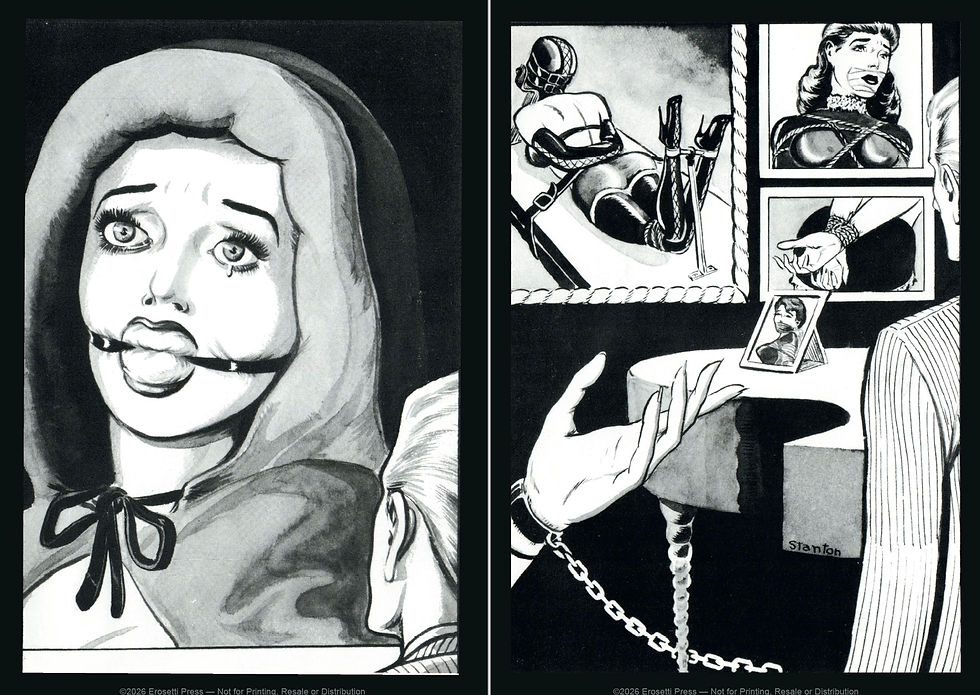
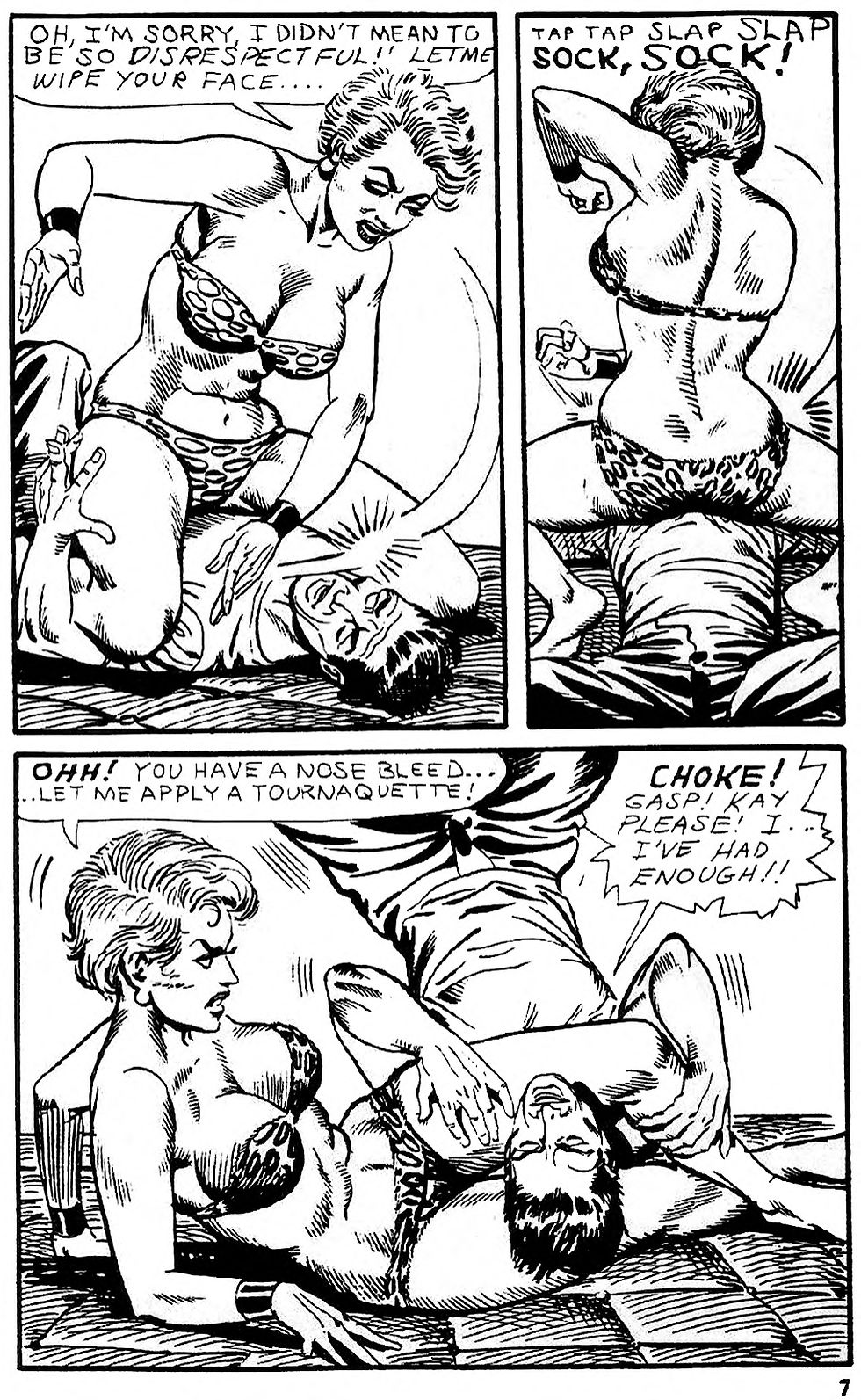
In the earliest phase, Stanton concentrated on “fighting femmes”: battling women, wrestlers, amazonian conflict, and the erotic charge of women as active rather than passive bodies. From there, under Klaw’s direction, he moved deeper into bondage, restraint devices, discipline schools, and elaborate power systems. Titles such as Girls’ Figure Training Academy and Madame Discipline emerged from this world, and with them Stanton’s true signature sharpened: command made beautiful, punishment made decorative, subjection made theatrical.
Nutrix, the imprint associated with Klaw’s later mail-order activity, became crucial to the afterlife of these works. The Bound in Leather material first appeared in 1953 and was later collected by Irving Klaw in 1961 as the Nutrix publication Bondage Enthusiasts Bound in Leather. That publication history is important because it clarifies what many readers intuited long ago: the 1961 edition was not just another cheap booklet, but a consolidation of one of Stanton’s most refined fetish-story cycles into a landmark underground object.
Eric Stanton Was a Storyteller of Power, Not Merely an Illustrator of Kink
To talk seriously about Stanton, you have to move beyond the lazy formulation that he “drew bondage.” What he really drew were systems of power. Again and again, his work stages inversion: women tower; men shrink; clothing reassigns identity; posture settles rank; ritual humiliates; authority eroticizes itself through control. The recurring appeal is not only erotic. It is dramatic. Readers enter a world where the ordinary order has been suspended and replaced with another one—stricter, more stylized, more dangerous, and often more honest about power than the polite world outside the page.

This is why so many of Stanton’s motifs recur across decades: high heels, corsets, gloves, leather dresses, maid uniforms, military echoes, finishing schools, punishment chambers, aristocratic hostesses, captive suitors, femmes who smile because the outcome was decided before the scene began. These are not random accessories. They are the furniture of a complete symbolic order. Stanton’s genius was not merely to fetishize objects, but to let objects become law.
Leather, Heels, Corsets, and the Architecture of Command
One of the most remarkable things about Stanton’s work is how consistently costume operates as destiny. A corset in Stanton is never just lovely. It constricts, defines, disciplines, and transforms the body into a statement of control. Boots do not simply adorn the leg; they harden it into command. Gloves render the hand cooler, more formal, less human, more absolute. Leather becomes the sheen of authority itself. A Stanton woman enters a room already armored by silhouette.

That is one reason Bondage Enthusiasts Bound in Leather matters so much as a title and as a concept. Leather, for Stanton, is not incidental material. It is a whole aesthetic logic. It promises polish, severity, theatricality, and the conversion of erotic play into visual order. In his world, satin, kid leather, polished boots, cinched waists, and restrictive sleeves are not secondary details. They are the language through which command announces itself.
Female Dominance and Why It Repeats
Stanton’s recurring emphasis on female dominance is one of the reasons he continues to feel so modern. He was drawing powerful women not as anomalies, but as the governing principle of the scene. Their dominance could be stern, mocking, maternal, aristocratic, punitive, comic, or ravishingly elegant, but it was almost always central. The page belonged to them.

That matters historically because Stanton’s underground art gave visual form to fantasies that mainstream mid-century American culture largely displaced, softened, or coded. His women are often larger than life because they are doing more than starring in a sex fantasy: they are reordering the visible world. They punish, instruct, correct, expose, train, transform, and command. Even when the work is playful or absurd, the emotional structure remains serious. Power has moved. The page records the transfer.
For many readers, that remains the key to Stanton’s enduring force. He did not merely eroticize domination. He aestheticized authority itself. He made hierarchy visible, glamorous, and unforgettable.
Humiliation, Transformation, and Costume-as-Fate
Stanton also understood something psychologically deep: that fetish frequently turns not only on pleasure, but on transformation. In his art, characters are very often being made into something. Dressed. Redressed. Restrained. Assigned. Corrected. Shamed. Displayed. Converted from one role to another. This is one reason themes of forced dressing, feminization, maid service, finishing schools, and humiliating discipline recur so strongly in his body of work. These are narrative engines of metamorphosis.
Clothing in Stanton is therefore never neutral. To be put into satin, leather, corsetry, or a service uniform is to have one’s place rewritten. He repeatedly dramatized the terror and thrill of becoming legible within someone else’s power system. That is why his work still feels psychologically sharper than much later fetish illustration. He understood that the real charge often lies not in restraint alone, but in being reclassified.
Stanton’s Humor: The Secret Ingredient Too Many Readers Miss
Another reason Stanton survives is humor. Paul Gravett’s obituary noted the wit and pictorial invention admired in his work, and that point is crucial. Stanton could be severe, but he was rarely dull. His scenes often contain exaggeration, absurdity, theatrical overstatement, or a sly cartoon intelligence that keeps the work from collapsing into monotony. His dominatrices are frightening, but often knowingly so. His submissives are humiliated, but often with a comic timing that reminds you Stanton never stopped being a cartoonist.
This humor matters because it prevents the work from becoming inertly pornographic. Stanton is frequently staging a performance. The pleasure lies partly in the excess: too many buckles, too much hauteur, too much ceremony, too much confidence, too much spectacle. The scene becomes a dark vaudeville of power. That combination of severity and wink is one of the reasons his best work still feels alive.
Steve Ditko, the Shared Studio, and the Strange Border Between Underground and Mainstream
Few details in Stanton’s biography are more fascinating than his long association with Steve Ditko. The Comics Journal notes that after studying at the Cartoonists and Illustrators School under Jerry Robinson, Ditko shared a studio with Eric Stanton from 1958 to 1968. That fact alone should permanently complicate any simplistic division between “respectable” comics history and the erotic underground. One of the defining artists of superhero modernity and one of the defining artists of fetish illustration worked side by side for a decade.
Collector lore has long built extravagant theories around this relationship, especially regarding mutual visual influence and possible collaboration. The hard documentary ground is narrower: they studied in the same orbit, shared working space for years, and moved through overlapping commercial-art worlds. Even that is enough to be revealing. Stanton was not some fringe naïf. He stood close to central currents of American comics craft. He belonged to the same New York ecology of deadlines, drawing boards, freelance hustles, and visual invention that produced major mainstream culture, even as his own kingdom remained defiantly underground.
Bettie Page, Paperback Covers, and the Reach of Stanton’s Visual Language
Stanton also worked on Klaw’s shoots with Bettie Page, placing him inside the wider sexploitation and fetish-image machine of the period. By the 1960s, as censorship loosened, he expanded into broader subject matter and painted some 300 paperback covers along with numerous interior illustrations. That number alone tells you his reach was larger than many casual readers assume. He was not only an underground specialist serving a tiny circle. He was also a highly productive commercial image-maker whose women circulated through mass-market paperback culture in astonishing volume.

His influence radiated far beyond the original niche. Gravett records that Madonna modeled one of her early images on the Stanton woman, and that Allen Jones admired the invention, graphic intensity, and humor of Stanton and his peers. Once you know Stanton’s visual vocabulary, those echoes become easier to spot: the cool dominatrix silhouette, the militarized high heel, the architectural corset, the woman as instrument of composed command rather than passive object. Fashion, pop iconography, fetish couture, and later erotic illustration all carry some trace of that inheritance.
Stantoons and the Direct-to-Collector Future
Another reason Stanton feels contemporary is that he anticipated the direct-to-audience model now common across niche publishing. After years of underpayment and lost art, he increasingly published for his own collector base. Later bibliographic records and histories note the Stantoons line, beginning in the early 1980s, along with his self-publishing through Stanton Archives. By the end of his life, he had produced a substantial body of direct-market fetish booklets that kept him in close contact with enthusiasts outside mainstream gatekeeping.

That matters now because Stanton solved problems that still define independent erotic publishing. How do you serve a very specific audience without diluting the specificity that makes the work valuable? How do you preserve artist identity inside a niche market? How do you sell directly to readers who understand exactly what they are seeking? Stanton’s answer was not compromise. It was intensity, authorship, and subcultural loyalty.
Why Bondage Enthusiasts Bound in Leather Is One of the Summit Works
Among Stanton’s many celebrated works, Bondage Enthusiasts Bound in Leather stands near the summit because it concentrates so much of what makes him singular. Publication records trace the material to earlier 1953 Bound in Leather installments, later collected in 1961 by Nutrix as Bondage Enthusiasts Bound in Leather. That 1961 form is the one that hardened into legend: elegant, glossy, self-contained, and saturated with the mature Stanton world of ritualized dominance, theatrical domesticity, costume discipline, and stylized surrender.
This is not merely “old fetish pulp.” It is Stanton at the point where the earlier fighting-femme energy, the Klaw-market apparatus, the discipline-school imagination, the fetish of leather and posture, and the cartoonist’s instinct for scenario all converge. The work feels luxurious and punitive at once. It is severe without being lifeless, kinky without being shapeless, ornate without losing visual authority. That is why so many collectors and historians continue to circle back to it.
Volume One: A Theatre, a Stranger, and a Descent Into Stanton’s Private Kingdom

Volume One opens in New York in 1961, in the velvet dark of a Broadway theater, where a chance encounter becomes initiation. A man’s attempt to sketch a glamorous stranger turns into an invitation, and that invitation becomes passage into one of Stanton’s most concentrated fantasy worlds. The woman is Vicki Roberts: sophisticated, severe, satin-clad, and fully at home in a domestic kingdom organized around discipline, fetish, and command. Before long, the narrator discovers that Vicki’s daughter Nicki may be even more voracious in appetite and imagination, and that the French maid Fifi already exists within a regime of punishment and containment.
What follows is quintessential Stanton: sky-high heels that alter movement itself, kid-leather gloves that formalize the hand, corsetry that turns breathing into discipline, and restrictive garments that convert the body into display and submission. The appeal of the story lies not in realism, but in atmosphere and escalation. It is a chamber play of fetish elegance. A household becomes a ritual stage. The reader is not merely shown a series of erotic images; the reader is ushered into a complete etiquette of power.
Why These Themes Recur — and Why They Matter
Why do leather, restraint, female command, punishment, forced posture, theatrical humiliation, and transformation recur so insistently in Stanton? Because these are not isolated kinks in his work. They are his way of dramatizing how power feels when it becomes visible. His art returns again and again to the moment when status ceases to be hidden and becomes physically legible—through clothing, stance, ritual, ceremony, and exposure.
That is why the work continues to matter beyond its original audience. Stanton’s pages expose something many polite cultural forms conceal: desire is frequently entangled with rank, with performance, with surrender, with embarrassment, with longing for order, with fear of exposure, with the eroticization of control, and with the intoxicating possibility of being remade. That does not mean every reader wants the same thing from the work. It means Stanton knew how to stage primal tensions in a heightened, unforgettable form.
He also matters because he belongs to a lineage of artists who transformed private obsession into visual culture. He did not apologize for specificity. He refined it. He made fetish illustration legible as style. That is a larger achievement than notoriety.
The Father of Modern Fetish Illustration

It is not hard to see why Stanton is so often called the father of modern fetish illustration. He occupies a peculiar and important place: too underground to be fully institutionalized, too influential to remain truly marginal. He stands at the junction of comics, mail-order erotica, paperback culture, pin-up economies, visual theater, and the long history of coded sexual subcultures. He helped define what later generations would inherit as the visual lexicon of domination: the gleam of leather, the sharpened heel, the imperial woman, the theatrical captive, the polished apparatus of command.
And yet what keeps him alive is not only influence. It is craft. Stanton could draw. He understood weight, gesture, staging, rhythm, silhouette, texture, and exaggeration. He understood how a boot should land on a page, how a gloved hand should hover, how a woman’s glance can establish hierarchy before a single action occurs. He made fetish illustration feel designed rather than merely improvised. That refinement is why he remains essential.
The Erosetti Press Restored Edition: Why This Publication Matters Now
That is exactly why this new Erosetti Press publication matters. Eric Stanton’s Bondage Enthusiasts Bound in Leather Volume One: Restored Edition gives contemporary readers a chance to encounter one of Stanton’s defining works not as rumor, photocopy, collector anecdote, or stray low-resolution scan, but as a deliberately framed edition for readers, collectors, and historians of erotic art. The book is listed on Amazon under Erosetti Press, and it should be sought out there and through the Erosetti Press shop.
What makes that significant is not merely access. It is restoration of context. Stanton’s work was born in a world of mail-order catalogs, coded sales copy, underground circulation, and objects that were often handled hard, hidden, damaged, or lost. A restored edition says that this work is not just to be consumed; it is to be preserved, read, revisited, studied, and appreciated as part of the history of fetish illustration and erotic storytelling.
For longtime Stanton admirers, this edition offers a return to one of the key texts of his mature mid-century aesthetic. For newer readers, it provides an ideal entry point into the private kingdom he built: elegant, merciless, humorous, theatrical, and still startlingly alive.
Read It — Then Hear It: Erotica Obscura and the Audio Afterlife of Stanton

Readers should also follow the work beyond the page. Erotica Obscura, the podcast of Erosetti Press, hosts a blog by Zhanna Z, a literary erotic podcast tied to blog-based criticism, readings, reflections, and immersive performances, with the show described on Spotify and Apple Podcasts as a space for intimate readings, analysis, and conversations about erotic literature and art. That makes it an especially fitting companion medium for Stanton, whose work has always lived halfway between illustration and performed fantasy.

So this volume should not only be read; it should be heard. The podcast version of this feature on the Erotica Obscura podcast blog extends Stanton’s world into voice, atmosphere, and narration, and it invites listeners into a complete reading of the Volume One story. That matters because Stanton was always more than an image-maker. He was a dramatist of fetish situations. Audio gives that theatricality another chamber to echo in.
Eric Stanton’s Afterlife
Eric Stanton died in 1999 at age seventy-two, but the world he drew never really disappeared. It migrated. It moved into fashion shoots, pop iconography, fetish clubs, graphic undergrounds, direct-mail collector circles, gallery rediscoveries, reprint culture, artist monographs, and the work of later illustrators who inherited his confidence whether they knew his name or not. His only lifetime gallery exhibition, at Danceteria in Manhattan in 1984, reportedly drew thousands. That was not an accident. It was proof that the “private” world Stanton built had always been larger than the culture pretending not to see it.
Today, the serious case for Stanton is straightforward. He is not important because he was scandalous. He is important because he was formative. He created one of the clearest visual languages of domination and fetish in American art. He fused cartoon intelligence with erotic ritual. He understood the psychological charge of costume, hierarchy, embarrassment, transformation, and ceremonial control. And he did it with a style so clean, so confident, and so theatrically exact that it still looks like authorship, not accident.
That is why Bondage Enthusiasts Bound in Leather Volume One deserves to be back in circulation. And that is why Eric Stanton deserves to be remembered not as a side-note
curiosity, but as one of the great underground image-makers of the twentieth century.
Read the Erosetti Press restored edition. Seek it out on Amazon and through the Erosetti Press site. Then continue the descent with the Erotica Obscura podcast blog, hosted by Zhanna Z, and listen to the complete reading of Volume One. Stanton built a private kingdom. This restored edition opens the gate.

More Eric Stanton from Erosetti Press
New restored editions of Eric Stantons fetish and bondage works are available at ErosettiPress.com, Amazon, all major online bookstores. Click to learn more:
©️ 2026 by Dante Remy


Comments